Drop a contract on it. It reads the trade for you.
A CTRM for small commodity trading desks and the trade finance professionals who fund them. Build the deal book from the documents you already have, see position and margin as prices move, and check every letter of credit before the bank finds the discrepancy.
The Standard product is free for life for the first 10 companies, and nothing in it is paywalled today. No card, no sales call.
“Standard product free for life for the first 10 customers. Premium modules will be priced when they arrive. Everything you sign up for today stays free.”
10
Founding places. When they are gone, Standard becomes a paid tier for everyone after you.
0
Features behind a paywall today. The premium set is deliberately empty; the free Standard product is the whole product.
Minutes
From signup to a working system, seeded with a starter pack for your commodities. Then drop one real document on it.
The whole book, built from the documents you already have
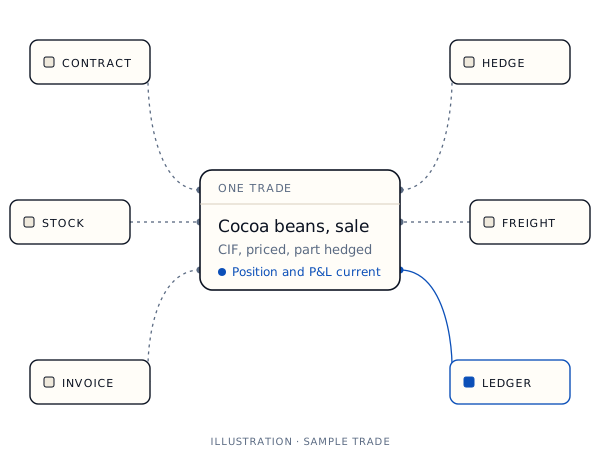
Point it at a deal recap, a broker offer or a signed contract, and it pulls out the parties, quantity, price, quality spec and shipment terms, shows you where every value came from, and files nothing until you confirm it. From there the system does what your spreadsheet pretends to:
- Deal book with flat, index, differential and provisional pricing, fixations and per-deal costs, financing carry and gross profit
- A merchandising position board: KPI tiles, by-commodity long/short, open-contract and futures blotters, all derived from the deals, never typed in twice; unpriced legs stay out of your flat position
- Hedging that answers “are you flat?”: per-broker margin, the projected call a price move would trigger, books, rolls and spreads, mark-to-market, FX on cross-currency trades
- Risk analytics (VaR, CFaR, PFE, stress), basis mark-to-market, KPIs with position limits
- The daily grind handled: exceptions queue, workflow rules and chase alerts, laytime and demurrage, port disbursement accounts, invoices and generated documents, banking with receipts auto-attributed to deals
- A documents inbox with its own email address: forward the paperwork in and the right deal's checklist ticks itself; counterparty 360 pages; save any deal as a template; per-user view/edit access per function
A real letter of credit workbench, not a status field
Paste the credit straight off the clipboard and work it the way a documentary credit specialist does:
- Workability review against the contract you actually struck, term by term, the day the credit is advised, not the day the documents are refused
- Back-to-back mirror: purchase credit against sale credit, mismatched terms surfaced side by side; soft clauses flagged
- Draft versus issued, amendments rolled into effective terms, volume declarations and issuance deadlines tracked; it writes the amendment request for you
- Document examination with findings and verdicts before presentation, built so it will not quietly pass a bad pack, and a sign-off trail
- Shipping instructions checked against the captured credit before they go to the seller, the last gate before a term error becomes a presentation discrepancy
- Letter of indemnity register with live exposure, so the paper you issued against missing documents is never out of sight
Read the autopsy: 8 defects the engine found between two perfectly reasonable credits →
What it does not do yet, and the complete CTRM it is becoming
Every gap the manual lists is on the roadmap. The destination is a complete CTRM for physical commodity desks that works alongside any accounting system. The founding ten decide the order.
First in line
- Accounting integration: your ledger stays your ledger. The self-serve edition deliberately has no general ledger of its own. Invoices, credit notes, banking and settlement live on the trade; the integration layer posts them to the accounting system you already run and reconciles receipts against it, starting with cloud packages such as Xero, extending to any ledger with an API or a journal import. Trading and accounts stay loosely coupled by design: a problem on the finance side never holds up the book.
- Live market data. Exchange settlement prices, FX rates and forward curves fetched, not typed. Until it ships, prices are entered by hand and a hedge with no price on file reads “not marked”, never a silent zero.
- Options modelled properly. Delta-adjusted cover instead of today’s deliberately conservative treatment, which counts options at full notional and flags them as overstating cover.
Behind those
- Sanctions and vessel screening. Parties, vessels and cargo origin checked against sanctions lists on the deal record, not in a separate tool.
- Freight. Quotes, booking and tracking attached to the deals they serve. Not in the self-serve edition today.
- The operations reporting layer. Shipment pipeline, supplier and buyer treemaps, debtor aging roll-ups and vessel-wise profitability. The position board, laytime, the hedge book and KPIs are already built; the wider dashboard is not.
- Alerts that leave the dashboard. Chase alerts and workflow rules delivered to email and messaging, so the system can nag the counterparty instead of you.
Further out
- Deeper metals mechanics. Warrants, borrow and lend rolls, fuller LME curve handling on top of the averaging, quotational-period and contingent-margin logic already in the hedge book.
- Third-party warehouse and inventory visibility. Stock at 3PL warehouses reconciled against the derived inventory the deal book already computes.
- More commodity packs. The pricing, quality and unit engines are commodity-neutral; each new pack is dictionaries and templates, sequenced by what founding desks trade.
- The small print the manual lists. LOI document upload, editable L/C and LOI policies from Settings, and the rest of the self-documented gaps list, closed in order of who asks.
No dates here, on purpose: the founding ten set the order, and we will not invent a date for a marketing page. Future premium modules will be priced when they arrive; founding companies keep everything that exists today, free. The manual also records where AI is used and where it is not, so you know which numbers come from arithmetic and which from a model. The wider platform’s direction is on the opsPhlo roadmap.
Three steps, no procurement cycle
1
Sign up with a work email. Company name, your commodity classes, done. No card, no call, no contract to redline.
2
Start on a working system. Your workspace is seeded with a starter pack for agricultural, metals or energy trading, so day one is not a blank screen.
3
Drop one real document on it. A deal recap, a broker offer, or an LC against its deal. Twenty minutes and you know whether it fits how you trade.
The fine print, in plain sight
Is this really free, or a trial that expires?
Not a trial. The wording recorded against every founding workspace is: “Standard product free for life for the first 10 customers. Premium modules will be priced when they arrive. Everything you sign up for today stays free.” The page you sign up on and the commitment on file are the same string, deliberately, so the promise cannot drift. You can read your own commitment record in Settings after you sign up.
Is anything paywalled today?
No. The premium gating mechanism exists in the code, and the set of premium features is deliberately empty. Everything described on this page is in the Standard product you get free. When premium modules arrive, they will be new capabilities, not things taken away from you.
Why free? What do you get out of it?
Ten design partners whose real deal flow shapes what we build next. Phlo Systems already runs full opsPhlo for larger trading houses; the self-serve edition is the standalone trading layer, and the first ten companies decide what gets built next.
How is the self-serve edition different from full opsPhlo?
Full opsPhlo is CTRM plus ERP: general ledger, multi-entity accounting, warehouse management, powered by Acumatica. The self-serve edition is the trading layer on its own: deal book, positions, hedging, the LC workbench, laytime, invoices and banking. As it grows into a complete CTRM it stays that way: loosely coupled, integrating with the accounting system you already run rather than replacing it. When a desk outgrows the self-serve edition, the upgrade path is a conversation, not a migration project.
Will it integrate with my accounting system?
That is the design intent, and it is why the self-serve edition deliberately does not bring its own general ledger. Invoices, credit notes, banking and settlement live on the trade; the accounting integration layer at the front of the roadmap posts them to the ledger you already run, starting with cloud packages such as Xero, extending to any accounting system with an API or a journal import. Your finance system stays the system of record for accounts. The self-serve edition stays the system of record for the trade. Neither ever holds the other up.
Is my book isolated from other tenants?
Each company gets its own workspace; every query is scoped to it with database row-level security. Your deal book is visible only to the users you invite, and role-based access controls who sees what inside your own team.
Which commodities are supported?
Agricultural and softs (cocoa, coffee, sugar, grains, edible oils), metals including LME-quoted business with averaging and quotational-period handling, and energy (thermal and coking coal, petcoke, refined products). Pricing supports flat, index, differential and provisional structures. The manual even ships glossaries for coal, metals, softs, grains and the SWIFT fields.
What happens when the 10 places are taken?
Standard becomes a paid tier for company number eleven onwards. Founding workspaces keep the free-for-life terms they signed up under.
Sign up now, or ask us to walk you through it
Signing up is the fastest way in. Not ready? Take the self-guided tour: seven stops from one forwarded email to a managed deal, no login needed.
If you would rather see it on your own trade flows, or check whether the LC workbench fits your practice, leave your details. We will show you on a real deal within one business day.